Sessions/Tracks
Track 1: Biofuels
This track explores the advancement of Renewable Alternatives for sustainable fuel production. Researchers will discuss innovative conversion technologies and feedstock optimization strategies. The session highlights emerging opportunities in transportation and industrial applications. Participants will examine commercialization pathways and market developments. Focus will be placed on reducing environmental impacts through cleaner fuel solutions. The track supports the transition toward a resilient energy future.
Track 2: Bioenergy
This track focuses on generating energy from biological resources using Integrated Systems and efficient nconversion processes. Discussions include power generation, heating applications, and decentralized energy solutions. Researchers will explore technologies that improve performance and sustainability. The session highlights the role of bioenergy in energy diversification. Participants will gain insights into innovative production models. Emphasis is placed on achieving Energy Resilience through renewable resources.
Track 3: Biomass
This track examines the utilization of OrganicFeedstocks for renewable energy generation. Researchers will discuss biomass collection, processing, and supply chain innovations. The session explores sustainable approaches for maximizing resource value. Topics include agricultural residues, forestry resources, and waste materials. Participants will evaluate technologies that enhance operational efficiency. The track promotes Resource Optimization across the bioenergy value chain.
Track 4: Feedstock
This track addresses the development of sustainable Biomass Resources for long-term energy production.Discussions focus on feedstock quality, availability, and logistics management. Researchers will exploreinnovative cultivation and sourcing strategies. The session highlights environmental and economic considerations.Participants will assess methods that strengthen supply security. The track supports Sustainable Procurement practices.
Track 5: Biorefining
This track explores advanced Processing Platforms that convert biomass into fuels, chemicals, and materials. Researchers will discuss integrated technologies that maximize resource utilization. The session highlights innovations in product diversification and industrial scalability. Topics include process efficiency and value-added production. Participants will explore commercial opportunities in the bio economy. The track promotes Industrial Sustainability through resource-efficient manufacturing.
Track 6: Hydrogen
This track focuses on renewable hydrogen technologies and their role in future energy systems. Researchers will examine Clean Molecules for industrial and transportation applications. Discussions include production, storage, and distribution strategies. The session highlights emerging opportunities in the hydrogen sector. Participants will explore innovative infrastructure developments. The track supports the growth of the Hydrogen Economy.
Track 7: Algae
This track explores algae as a versatile platform for renewable energy production. Researchers will discuss Cultivation Technologies and biomass enhancement strategies. Topics include fuel generation, carbon capture, and wastewater integration. The session highlights commercialization opportunities and environmental benefits. Participants will evaluate scalability and economic feasibility. The track promotes Blue-Green Innovation for sustainable development.
Track 8: Bioconversion
This track focuses on biological pathways that transform biomass into valuable products. Researchers will explore Microbial Engineering and enzyme-based technologies. Discussions include fermentation optimization and process improvement. The session highlights advances in renewable fuel production. Participants will examine industrial applications and scalability. The track advances Bioprocess Excellence.
Track 9: Gasification
This track examines thermochemical technologies for converting biomass into useful energy carriers. Researchers will discuss Syngas Applications and reactor innovations. Topics include process optimization and industrial deployment. The session highlights efficiency improvements and sustainability benefits. Participants will explore advanced gas cleaning technologies. The track supports Clean Conversion solutions.
Track 10: Pyrolysis
This track explores thermal conversion systems that generate bio-oil and biochar. Researchers will discuss Reactor Innovation and product upgrading technologies. The session highlights waste valorization opportunities. Participants will examine carbon management applications. Discussions focus on commercial scalability and efficiency enhancement. The track promotes Carbon Utilization strategies.
Track 11: Decarbonization
This track addresses technologies and policies aimed at reducing emissions. Researchers will explore Climate Solutions across energy and industrial sectors. Discussions include carbon mitigation and sustainability strategies. The session highlights pathways toward net-zero targets. Participants will evaluate low-carbon innovations. The track advances Emission Management initiatives.
Track 12: Sustainability
This track focuses on balancing environmental, social, and economic priorities. Researchers will discussResponsible Development and lifecycle assessment methodologies. Topics include resource conservationand ecological protection. The session highlights sustainable innovation practices. Participants willexplore longterm growth strategies. The track promotes Environmental Stewardship.
Track 13: Circularity
This track explores circular economy principles within renewable energy systems. Researchers will discuss Waste Recovery and material reuse strategies. Topics include industrial symbiosis and resource efficiency. The session highlights regenerative production models. Participants will evaluate sustainable business opportunities. The track supports Closed-Loop Operations.
Track 14: Valorization
This track focuses on transforming underutilized resources into high-value products. Researchers will explore Product Innovation and advanced recovery technologies. Discussions include market development and commercialization. The session highlights economic and environmental benefits. Participants will examine sustainable production pathways. The track advances Value Enhancement.
Track 15: Mobility
This track examines renewable energy solutions for transportation sectors. Researchers will discuss Alternative Fuels for aviation, maritime, rail, and road transport. Topics include infrastructure readiness and fuel performance. The session highlights low-emission mobility systems. Participants will explore future transportation trends. The track supports Transport Transformation.
Track 16: Storage
This track explores advanced energy storage technologies supporting renewable energy systems.Researchers will discuss Storage Solutions for improving energy reliability and flexibility.Topics include thermal storage, hydrogen storage, and hybrid energy systems.The session highlights innovations that enhance operational stability and efficiency.Participants will examine large-scale deployment opportunities and technical challenges.
The track promotes Grid Reliability for future sustainable energy networks.
Track 17: Digitalization
This track focuses on the digital transformation of bioenergy operations and infrastructure.Researchers will explore Smart Platforms that improve monitoring and process control.Topics include IoT, cloud computing, and digital twin technologies.The session highlights real-time data management and performance optimization.Participants will examine technologies that enhance operational transparency.The track advances Digital Excellence across renewable energy systems.
Track 18: Automation
This track examines intelligent automation technologies in modern bioenergy facilities.Researchers will discuss Autonomous Operations that improve productivity and safety.Topics include robotics, control systems, and process optimization.The session highlights advancements in smart manufacturing environments.Participants will explore scalable solutions for industrial applications.The track supports Operational Efficiency through advanced automation.
Track 19: Intelligence
This track explores the application of artificial intelligence within renewable energy sectors.Researchers will investigate Machine Learning models for process optimization.Topics include predictive analytics, forecasting, and intelligent decision support.The session highlights AI-driven innovations for sustainable energy management.Participants will explore emerging technologies transforming industrial operations.The track promotes Cognitive Technologies for future energy systems.
Track 20: Analytics
This track focuses on advanced analytical tools that improve energy performance.Researchers will discuss Predictive Insights derived from large-scale datasets.Topics include forecasting, risk assessment, and resource optimization.The session highlights data-driven approaches to decision-making.Participants will examine methods that improve operational performance.The track strengthens Strategic Planning through advanced analytics.
Track 21: Innovation
This track showcases breakthrough technologies and emerging opportunities in bioenergy.Researchers will present Novel Solutions addressing global energy challenges.Topics include advanced materials, conversion technologies, and commercialization.The session highlights disruptive innovations with industrial potential.Participants will explore collaborative approaches to technology development.The track drives Future Advancement across renewable energy sectors.
Track 22: Electrification
This track explores the integration of renewable energy into modern electricity systems.Researchers will discuss Clean Electricity generation and distribution solutions.Topics include smart grids, distributed energy, and power system modernization.The session highlights opportunities for expanding sustainable energy access.Participants will evaluate innovative approaches to energy infrastructure.The track supports Power Transformation for a low-carbon future.
Track 23: Integration
This track focuses on combining renewable technologies for improved system performance.Researchers will explore Hybrid Solutions involving bioenergy, solar, wind, and hydrogen.Topics include interoperability, energy balancing, and system optimization.The session highlights resilient approaches to energy management.Participants will examine multi-source energy strategies.The track advances System Synergy across renewable energy networks.
Track 24: Governance
This track examines policies and regulatory frameworks shaping renewable energy development.Researchers will discuss Policy Innovation supporting sustainable growth.Topics include regulations, standards, and international collaboration.The session highlights governance mechanisms that encourage investment.Participants will explore strategies for effective sector management.The track promotes Institutional Excellence in energy transition initiatives.
Track 25: Transition
This track addresses the global shift toward sustainable energy economies.Researchers will discussTransformational Change across industrial and energy sectors.Topics include decarbonization pathways, investment strategies, and technology adoption.The session highlights long-term approaches to achieving climate goals.Participants will evaluate opportunities for sustainable economic growth.The track acceletes the Green Transition ratoward a resilient energy future.
Market Analysis
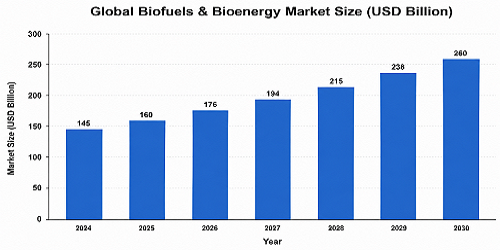
The global biofuels and bioenergy market is witnessing substantial growth, driven by increasing demand for sustainable energy solutions, rising environmental concerns, and global efforts to reduce greenhouse gas emissions. The market was valued at approximately USD 145 billion in 2024 and is projected to exceed USD 260 billion by 2030, growing at a Compound Annual Growth Rate (CAGR) of around 10.2%. This expansion is fueled by supportive government policies, renewable fuel mandates, growing investments in advanced biofuel technologies, and the increasing adoption of sustainable transportation fuels. The demand for bioethanol, biodiesel, renewable diesel, and sustainable aviation fuel (SAF), and next-generation biofuels continues to rise as industries seek low-carbon alternatives to conventional fossil fuels. Technological advancements in biomass conversion, feedstock optimization, bio refineries, and waste-to-energy systems are further accelerating market growth and enhancing production efficiency.North America remains a leading market due to strong renewable energy policies, advanced biofuel production infrastructure, and significant investments in research and development. Europe continues to drive innovation through ambitious climate targets, carbon reduction strategies, and widespread adoption of sustainable energy technologies. Meanwhile, the Asia-Pacific region is emerging as the fastest-growing market, supported by rapid industrialization, increasing energy demand, government incentives, and expanding investments in renewable energy infrastructure. Countries such as China, India, Japan, and South Korea are playing a crucial role in advancing biofuel production, biomass utilization, and sustainable energy deployment.
The future of the biofuels and bioenergy sector is being shaped by breakthroughs in advanced biofuels, sustainable aviation fuels, renewable hydrogen integration, carbon capture technologies, artificial intelligence-driven process optimization, and circular bio economy models. Increasing collaboration among research institutions, energy companies, policymakers, technology providers, and investors is accelerating the commercialization of innovative bioenergy solutions. As nations continue pursuing net-zero emission targets and long-term energy security, biofuels and bioenergy are expected to become essential components of the global renewable energy landscape. This rapidly evolving market presents significant opportunities for scientific advancement, industrial innovation, strategic investment, and sustainable economic development, making it one of the most dynamic and promising sectors in the global energy transition.